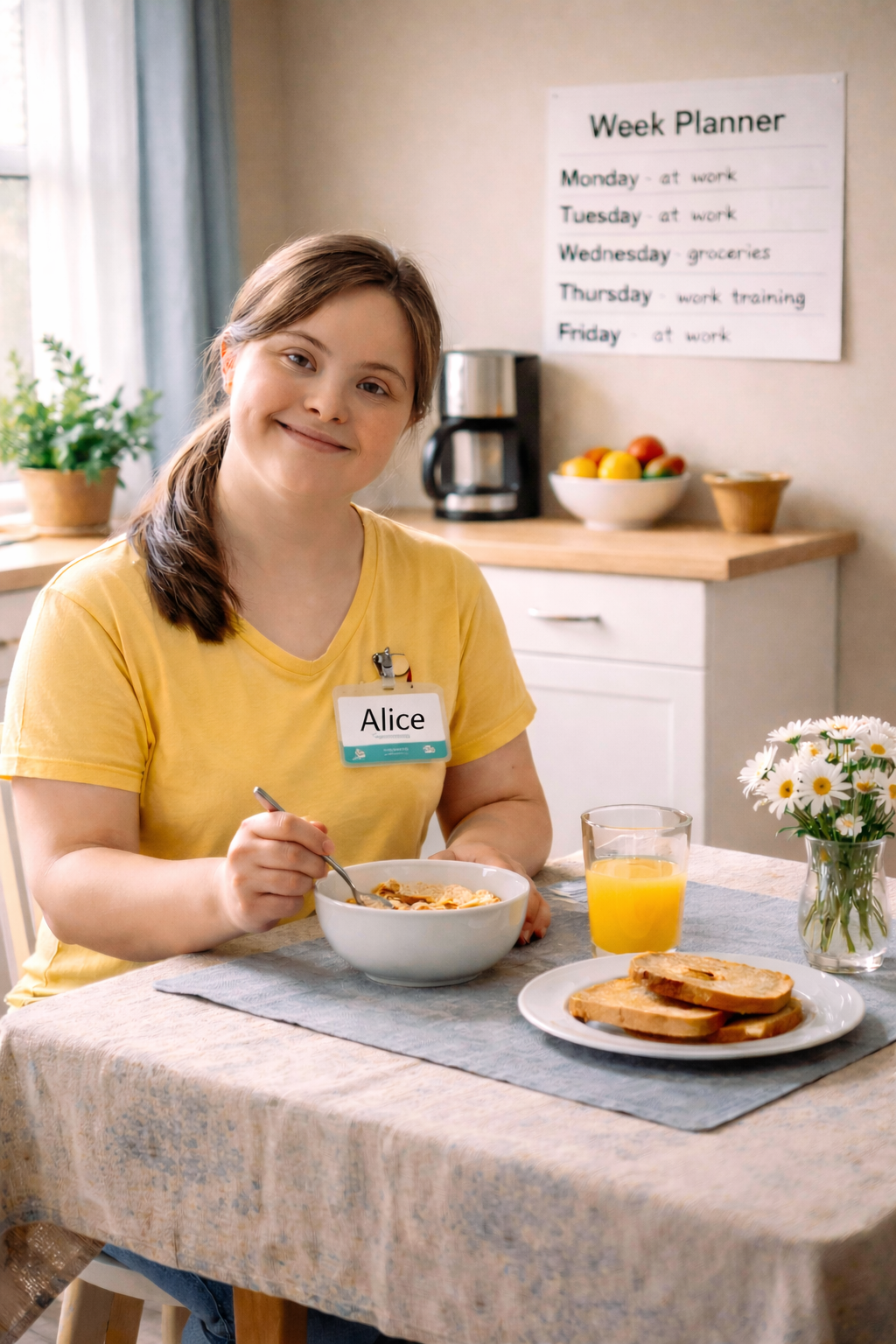
Alice woke up on her own today.
Not because someone reminded her. Not because an alert went off. Not because someone was watching.
She woke up because it was time to wake up.
Light came in through the window the same way it always does. The house was quiet in a way that felt settled. Not empty, not tense, just calm and familiar.
She followed her morning routine, the one she has practiced and adjusted and made her own. Breakfast. Getting dressed. The quiet confidence of a person moving through her own life.
Nothing happened.
And that is the part that matters most.
For a long time, we learned to measure independence by disruption.
By moments that break routine. By events that demand a response. By questions that start with what if.
What if someone falls? What if a door opens at the wrong time? What if no one notices?
Those questions are real. They come from love and from responsibility and from fear we rarely say out loud.
But they have shaped the way we design support.
We have built systems that are very good at noticing when something goes wrong, and far less skilled at recognizing when things are going right.
Alice went to work today.
She left on time and she came home on time. She moved through her day the way she usually does.
From the outside it looks uneventful. Almost invisible.
But for Alice and for the people who care about her, this is independence.
Independence is not an abstract goal. It is continuity. It is flow. It is a life that feels whole.
There was a time when Alice’s family lived inside constant vigilance.
Not because they did not trust her, but because the world around them offered very few ways to feel truly at ease.
Peace of mind came from checking in. From confirming. From staying alert even when nothing seemed wrong.
Support meant attention. Safety meant presence.
And over time that kind of care becomes heavy, even when it is given with love.
What we rarely talk about is how exhausting it is to live only inside reaction.
When support systems are designed around crisis, everyone carries the emotional cost. Families hold their breath. Staff stay on edge. Providers document endlessly.
And still reassurance feels fragile.
Because the absence of a problem isn’t the same as confidence that everything is okay.
But something quieter and more hopeful is starting to take shape.
A recognition that independence does not announce itself.
It does not live in dramatic milestones or emergency moments.
It lives in patterns.
In mornings that unfold as expected. In routines that hold steady. In days that feel familiar enough to belong to the person living them.
Alice does not experience independence as being left alone.
She experiences it as being understood.
Her rhythms. Her routines. Her way of moving through the world.
When those things are respected, safety does not feel like supervision. Support does not feel like control.
It feels like confidence.
This is the future we are beginning to imagine more clearly.
A future where independence is not proven by how quickly someone responds but by how rarely they need to.
Where dignity does not have to be defended because it is woven into how support is designed.
Where a good day is not one where everything was monitored but one where everything simply worked.
Today Alice made dinner. She followed her routine. She settled in for the evening.
Nothing happened.
And that is not an absence of care.
That is success.
Founder, LIViQ